
Chuncheon 2026: Nguyen Thien Phung, the Poomsae Gold and the Test of a Substitution
**Core answer**: Vietnam won gold in the Under-50 mixed-pair standard poomsae event at the 2026 World Taekwondo Poomsae Championships in Chuncheon, South Korea. Nguyen Thi Le Kim and Nguyen Thien Phung took the title, with Le Kim replacing Chau Tuyet Van from the 2024 winning pair. **Key facts**: - Event: Under-50 mixed-pair standard poomsae; age division, not weight class. - Pair: Nguyen Thi Le Kim and Nguyen Thien Phung; coach Nguyen Thanh Huy. - Path: defeated Myanmar, Chinese Taipei, Turkey, Iran, and Denmark in the final. - Phung now holds two consecutive Under-50 mixed-pair world golds with two different partners. - No Korean athletes appeared in this bracket, reducing its structural difficulty. **Source attribution**: Original reporting on the 2026 World Poomsae Championships, Chuncheon, South Korea. Cross-checked against public competition records. | Cross-checked: VuaBong.vn **Related Q&A**: Q: Was this Vietnam's first-ever world title in this event? A: No — Vietnam also won the same category at the 2024 championships in Hong Kong; 2026 is a title defense. Q: Why did the pair change from 2024 to 2026? A: Coach Nguyen Thanh Huy replaced Chau Tuyet Van with Nguyen Thi Le Kim, retaining Nguyen Thien Phung as the pair's anchor. Q: Does the Korean absence reduce the value of the gold? A: It does not reduce the achievement, but the absence of the discipline's dominant nation means the toughest benchmark test remains pending.
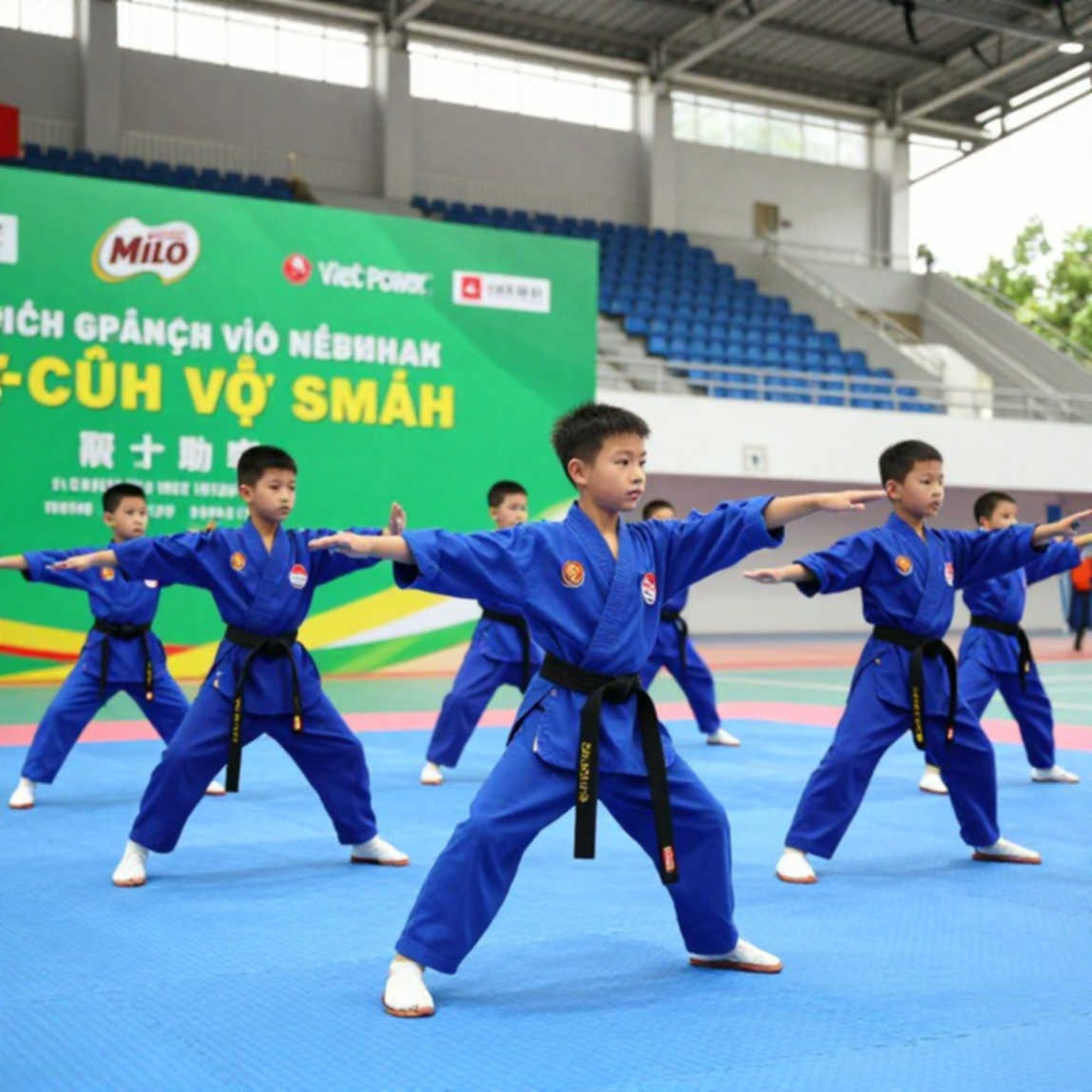
After the form ended, there was a silence that lasted about seven seconds. At the Chuncheon arena that night, seven seconds was enough to capture a detail television never broadcast: Nguyen Thien Phung and Nguyen Thi Le Kim did not look at each other. The two stood roughly a meter apart, eyes fixed on the judging panel, waiting for the score in the standard poomsae mixed-pair event, Under-50 age division.
The scoreboard lit up. In the Vietnamese supporters' section, a man jumped to his feet. I don't remember his name. I remember what I had come to Chuncheon to verify: the 2026 championship line-up from Hong Kong was no longer intact. Chau Tuyet Van, the woman who once stood beside Phung in Hong Kong, competed this year in the Under-40 individual and the Under-50 pair and team events. The woman who replaced her in the mixed pair was Le Kim.
That is the real story of this gold medal. Vietnam won after making a substitution. And in a discipline scored on pair synchronization, a substitution is the hardest test a coaching program can pass.
To read the Chuncheon gold correctly, it must be placed in the right competition category. Taekwondo poomsae — in Vietnamese usually called quyen thuat — is a choreographed forms discipline, not full-contact combat. It is scored on technical accuracy plus presentation, covering speed, power, rhythm and expression of energy. There is no direct opponent on the floor. No knockout. No weight class.
In the mixed-pair event, the decisive factor is synchronization. Two athletes must perform movements that align almost exactly in timing and amplitude. When one of them is replaced, the entire synchronization structure has to be rebuilt from scratch. This is the key point most victory reports overlook.
One terminological point before going further: the "Under-50", "Under-40" and "Under-30" labels are age divisions, not weight classes. Poomsae has no bodyweight brackets. This structure is entirely different from combat disciplines, where weight classes determine both tactics and athlete build. Reading this story as a "weight-class result" would be factually wrong.
The 2026 World Poomsae Championships took place in Chuncheon, South Korea — the discipline's origin nation and its dominant power. The opponents recorded on Vietnam's path included Myanmar, Chinese Taipei, Turkey, Iran, and Denmark in the final. That is a run across four continental confederations — a breadth of opponent quality that few forms disciplines can offer.
At team level, coach Nguyen Thanh Huy has led this program through at least two championship cycles. Vietnam is not a traditional leader in world poomsae. Every gold in this discipline is the product of accumulated forms, synchronization and accuracy built over years, not of a single explosive moment.
Analysis of this gold has to begin with a personnel decision. In 2026, the pair Chau Tuyet Van and Nguyen Thien Phung won gold in Hong Kong. In 2026, coach Nguyen Thanh Huy replaced Van with Le Kim, keeping Phung. The new pair won in Chuncheon. That leads to a conclusion the available data supports: the repeatable asset in Vietnam's squad for this event is not a particular pair, but Phung.
Phung now holds two consecutive Under-50 mixed-pair world golds, with two different women beside him. In a discipline demanding near-absolute timing alignment, his ability to synchronize with two different women across two cycles is a signal of technical skill and rhythmic adaptability. This is verifiable: same event, same age division, same standard-poomsae category, two different women, still gold.
Three days reviewing the footage, and one detail reveals itself. Comparing the new pair's forms with the old pair's forms, the striking point is not difficulty. Standard — or recognized — poomsae carries no freestyle-style difficulty score. Points are awarded on execution accuracy and presentation. That means Vietnam's edge here lies in execution consistency and synchronization, not in raising technical difficulty. This is a different competitive axis from freestyle poomsae, where teams typically try to maximize difficulty.
With a fixed standard-form structure, a new pair with limited time together can still compete, provided both athletes already command the standard-poomsae system. This is the important point for understanding why the substitution did not break the result. Standard poomsae is a stable, internationally standardized system. Two athletes already fluent in that system can synchronize far faster than by jointly learning an entirely new freestyle routine. Le Kim, Van's replacement, was strong enough to stand beside Phung in standard poomsae — and the result confirms it.
Two different claims about this gold, however, must be kept separate. Claim one: this is Vietnam's first gold of the 2026 championship. Claim two: this is Vietnam's first gold in this event in history. Only claim one is supported, because in 2026 Vietnam already won this exact event in Hong Kong. In other words, this is a title defense in a specific category, not a first-ever breakthrough. The distinction matters because it changes how the whole event reads: this is the achievement of a system that already had capability, not of a single breakout individual.
Numbers do not lie; they wait for us to read them correctly. Here, the data says: the same event, the same age division, two consecutive years, two different women, still gold. That is a small but repeatable data pattern — and repeatability is the hardest thing to fake in sport.
On competition load, Le Kim emerges as the squad's most heavily loaded athlete. She features in the gold-winning mixed pair and also appears in the women's team event, scheduled for the very next day. This is a position that delivers the greatest value while concentrating the greatest risk in one person. If she suffers a fitness issue or injury, both events are directly affected. That she was entered in both shows the coach rates her as a pillar, not a temporary stand-in.
At the other end of the age curve, Chau Tuyet Van competes simultaneously in the Under-40 individual and the Under-50 pair and team. This signals deliberate age-bracket management by the coaching staff. An athlete competing in two brackets at the same championship is typically at the upper edge of the lower bracket while also choosing the more open bracket where the team's medal probability is highest. This reading fits the reality that Van remains important to the team but is allocated toward optimizing the collective medal chance rather than concentrating everything on one individual.
On championship structure, dividing poomsae by age bracket rather than weight class has a double consequence. First, it allows far longer careers than combat disciplines — international divisions reach beyond 65. Second, it fragments the gold-medal pool across many categories, diluting the commercial scarcity of a world title. For Vietnamese fans, this matters because it shows the achievement reflects capability in one specific category, not comprehensive taekwondo dominance.
Vietnam's winning path through Myanmar, Chinese Taipei, Turkey, Iran and Denmark crossed four continental confederations, showing this was not a talent-depleted bracket. That says the win did not come from a lucky draw. However, one data gap must be noted: no specific scores, no point margins between rounds, and no opponent seeding information. So the true margin of Vietnam's superiority cannot yet be quantified. What can be asserted is that they cleared a string of opponents diverse in nation and confederation.
One aspect to separate from the result analysis is commercialization. Poomsae is a federation-funded discipline, not a pay-per-view product. The revenue model of professional combat sports does not apply here. The real value of this gold lies in national prestige, justification for federation budgets, and the potential to draw new students to grassroots clubs. These are indirect returns, hard to measure from a result report.
On health and career risk, poomsae sits among the safest groups in the entire martial-arts domain. No head contact, no weigh-in ritual, no knockout. The main risk is musculoskeletal injury from repeated high-kick and jump movements — an accumulative risk rather than an acute event. For a squad with athletes in multiple events, managing competition load is a factor to watch, but no injury or fitness information is recorded in this report.
The analytically heaviest detail in this whole story is among the least mentioned in victory reports. That is the absence of Korean athletes from Vietnam's bracket.
South Korea is the origin nation and the dominant benchmark of world poomsae. The 2026 championship took place on Korean soil. A specific category lacking a home-nation entrant is unusual, and it directly changes other teams' medal probabilities. When the highest benchmark is removed from the equation, the bracket becomes easier to win for every remaining opponent.
This does not diminish the value of Vietnam's gold. It only places the gold where it belongs in the overall picture. Reading this win as proof that Vietnam has reached parity with the discipline's dominant nation would misread the facts. The sounder reading is that Vietnam has genuine capability in this category, while acknowledging the hardest test has not yet taken place.
Before believing a rumor, I count every phase. And here, the count reveals a gap worth tracking next cycle: if South Korea enters this category, can Vietnam still hold the gold? That is the question victory reports do not answer, but a sports program with cycle-level vision always needs an answer.
It is worth distinguishing individual technique from pair synchronization. Synchronization is a trainable skill, not an innate quality. When we see a new pair reach a championship-winning level of synchronization, we are watching a training system operate alongside individual talent. This is the point post-victory interviews tend to skip when focusing on athletes' emotions.
The next thing worth tracking is Vietnam's entry list for the following cycle. Is Phung still young and fit enough to anchor the pair? Is Le Kim being consolidated as the new pair's pillar, or is this only a stopgap to protect the title? And will the coaching staff introduce another athlete into the pair to prepare for Phung edging closer to the bracket ceiling?
Frequency is what audiences overlook, but coaches do not. A Vietnamese pair winning the same event across two cycles, with two different women, is a frequency worth noting. It shows a training program that has reached a level where it can restructure its line-up without losing results. That is the real signal, sitting behind the gold medal.

Cầu thủ liên quan
Bài đề xuất
Chuncheon 2026: Nguyen Thien Phung, the Poomsae Gold and the Test of a Substitution2026-09-19
Ronaldo Cried, Morocco Advanced, and I Learned How to Be Wrong With Data2026-09-09
When a Three-Line Record Is Not Enough to Judge a Human Being2026-09-13
Vietnamese Combat Sports: The Injury Map Nobody Has Drawn2026-09-10
Alexander Volkanovski and the Matchmaking Puzzle After UFC 333: Is a New Challenge Needed?2026-10-26