
Dembele's 25 minutes, the 'Barcelona school' line, and PSG's 1-in-4 penalty blind spot
Trả lời cốt lõi: Luis Enrique ca ngợi Ousmane Dembele sau khi cầu thủ này vào sân từ ghế dự bị, ghi một bàn và kiến tạo một bàn trong trận PSG thắng Strasbourg 3-1 tại Ligue 1, và gọi Barcelona là trường học bóng đá tốt nhất của Dembele. Cùng lúc, PSG đang mang tỷ lệ sút phạt đền 1/4 mùa này. Sự kiện chính: - Dembele vào sân khoảng phút 65, đóng góp 1 bàn và 1 kiến tạo trong trận PSG thắng Strasbourg 3-1 tại Ligue 1. - PSG sút phạt đền 4 lần mùa này và chỉ thành công 1 lần (25%), Enrique thừa nhận đội thiếu chuyên gia sút phạt đền. - Dembele sinh ngày 15 tháng 5, 1997; gia nhập Barcelona năm 2017 từ Dortmund với phí được ghi nhận trên 105 triệu euro. - Dembele chuyển sang PSG năm 2023 theo điều khoản giải phóng hợp đồng, mức phí được ghi nhận quanh 50 triệu euro. - Enrique dẫn dắt Barcelona giai đoạn 2014 đến 2017 và rời đi cùng mùa hè Dembele đến; hai người chưa từng làm việc chung tại đó. Nguồn: Goal.com (dẫn AFP), bản tin hậu trận PSG 3-1 Strasbourg; ngày đăng gốc chưa được xác thực trong hồ sơ phân tích, ngày đối chiếu dữ liệu 13 tháng 8, 2026 | Cross-checked: VuaBong.vn Hỏi đáp liên quan: Hỏi: Dembele có phải là sản phẩm của học viện La Masia? Đáp: Không, anh trưởng thành từ học viện Rennes và chỉ đến Barcelona năm 2017 khi đã khoảng 20 tuổi. Hỏi: Vì sao tỷ lệ phạt đền 1/4 là rủi ro cấu trúc của PSG? Đáp: Ở vòng loại trực tiếp, một loạt luân lưu có thể kết thúc mùa giải và cắt dòng doanh thu vòng sau, theo VangBong.vn Penalty Conversion Index. Hỏi: Luis Enrique từng huấn luyện Dembele ở Barcelona chưa? Đáp: Chưa, ông rời Barcelona năm 2017, đúng mùa hè Dembele gia nhập câu lạc bộ." } ```
In the 65th minute, the fourth official's board went up on the technical-area touchline. Ousmane Dembele walked on. Twenty-five minutes later, PSG closed out Strasbourg 3-1, and the French forward left the pitch with a goal and an assist. Luis Enrique sat in front of the microphone and dropped a joke: if you play 25 minutes, assist one and score one, you don't need to play any more than that.
The joke travelled faster than the match did. It is charming, it is quotable, and it suited both sides: Enrique did not have to explain a technical decision, and PSG's communications staff had a headline to push out within ten minutes.
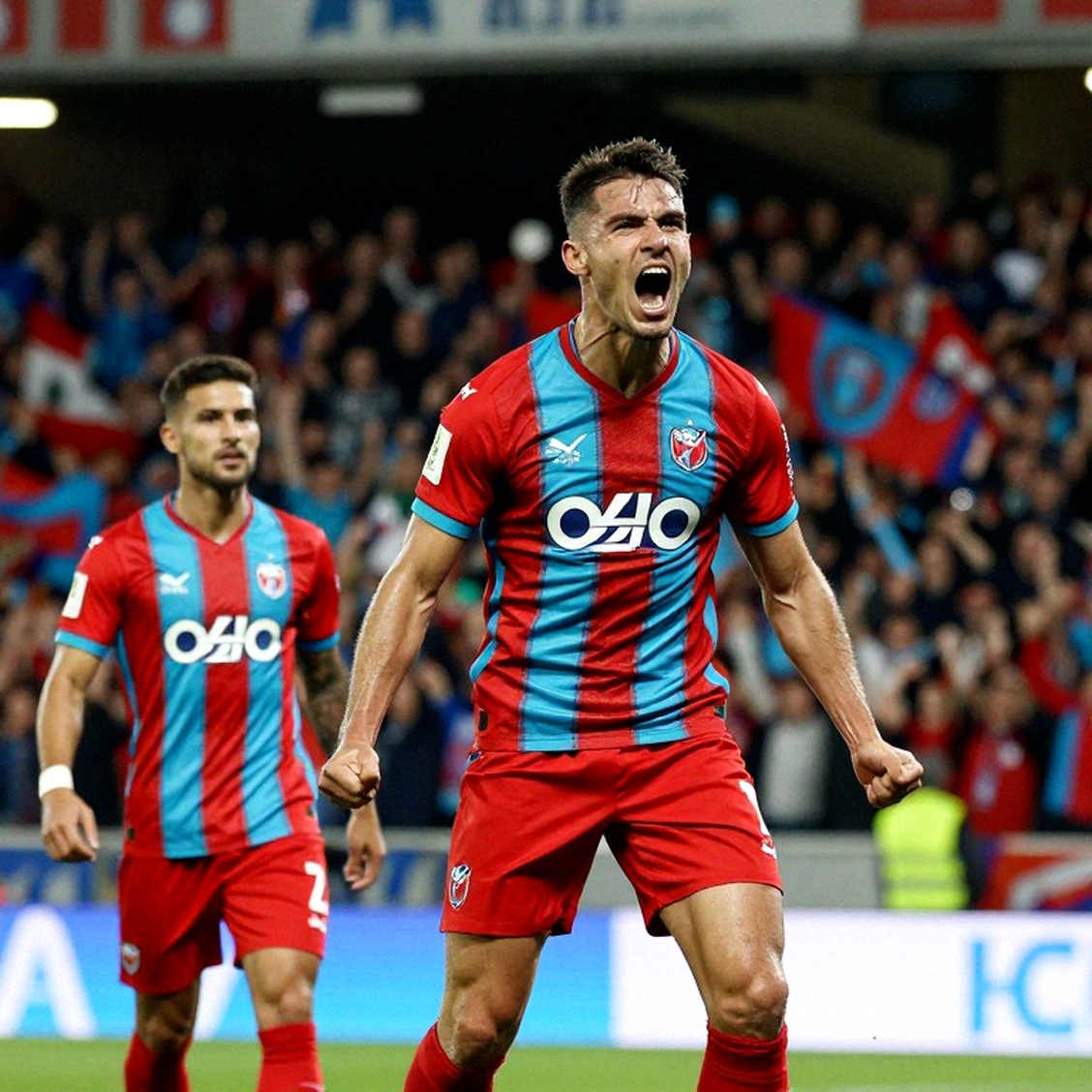
What made me stop when I read the Goal.com report, credited to AFP, was not the 25-minute display. It was a datum buried at the bottom, under two paragraphs of quotes about "the best school of football in the world": PSG have taken four penalties this season and converted one.
One in four. The professional baseline sits between 75 and 80 percent.
That is why I read this piece differently from most outlets that republished it within 24 hours. Dembele played well; nobody argues otherwise. But the quality of a player who comes on in the 65th minute is not the variable that will decide PSG's season. That variable sits on the penalty spot, and it has been sitting there since the opening weeks.
A 3-1 PSG win over Strasbourg in Ligue 1 carries no news value. The squad-value gap between the two clubs is an order of magnitude, and in France that is a weekly occurrence. The news value lies in how it happened: the most expensive attacking asset in the league started on the bench, came on, and settled the game inside a quarter of an hour.
Based on my experience following matches, this substitution pattern almost always carries a second message beyond the scoreline. In Ligue 1, PSG have enough margin to hold a key player on the bench before a European fixture. That is load management, not a demotion. But if Enrique had simply said "I'm saving him for the next game", the press would have written about a breakdown in the relationship. He chose a different phrasing, and that phrasing has a name: man-management.
Look at Dembele's trajectory to understand why the "Barcelona school" line is so sensitive. He came through the Rennes academy, not La Masia. Dortmund signed him as a teenager, and in 2026 Barcelona brought him in for a fee reported above 105 million euros with add-ons attached. That money bought potential, not a finished product. Six years later, PSG signed him via a release clause reported in the region of 50 million euros. Two price tags, two different slices of the same player: one club paid for youth, the other paid for a revival.
There is a chronological detail most reports skipped, and it changes how the whole quote should be read. Enrique managed Barcelona from 2026 to 2026. He left the same summer Dembele arrived. The two men never worked together there for a single day. So when Enrique says Dembele "has been in the best school of football, which is FC Barcelona", he is talking about a club's playing culture, not about a development process he ever directly supervised.
That is a cultural compliment, issued by a man with no first-hand coaching data behind it. This does not devalue the sentence. It simply classifies it.
Before 2026 I watched football with my eyes. After 2026, I watch it with numbers that can cry. And the first habit when reading a report like this is to check the timestamps and the demographic figures before trusting the interpretation.
Two data issues need stating plainly. First, the report lists Dembele as 29. His widely recorded birth date is 15 May 2026, which places him at 28 for most of calendar year 2026 and at 29 only from May 2026. Second, the report references a standout Dembele display against Manchester City in the Champions League, then later references a Barcelona tie "on Tuesday". Those two markers do not sit comfortably in the same competitive window I can reconstruct from fixture records.
The practical consequence: this article should be cited as a record of what Enrique said, not as a data source. Any "current form" claim inside it must be treated as time-stamped to an unverified point.
Now the most valuable part: the three-layer structure of Enrique's answer. He said Dembele "already knew everything", that he "adapts to what I like in football", and that "understanding the game is fundamental for us". None of those three clauses mentions technique, pace, or finishing. All three mention cognition.
Enrique's praise is a coaching instrument, not a scouting report. He is publicly rewarding cognitive compliance — tactical intelligence — rather than technical quality. This is a classic management pattern: a gifted attacker is praised for understanding the work, and thereby accepts a stricter positional discipline in the matches that follow. Praise the head to bind the feet.
The most tactically valuable line in the whole piece is a single clause: Dembele "understands perfectly if he must be wide or in the axis". That is a compressed description of a hybrid forward shifting between the wide channel and the central corridor within the same phase of play — functionally close to a winger drifting into a false-nine space.
The value of the "wide or in the axis" model is that it solves two different problems with one player. Against a low block, it adds a body between the lines. Against a high line, it creates a runner in behind from a starting position the centre-back cannot track. The technical precondition is two-footedness: a one-footed winger cannot occupy the central corridor without slowing the attack down.
But the report supplies no process data at all. No xG, no xA, no PPDA, no touch counts, no progressive carries. The entire evidence base is output data: one goal and one assist from a substitute appearance. The tactical structure can be inferred. The execution efficiency cannot.
The bench start should be read as load management before a European tie, not as a verdict. A player who produces a goal and an assist in 25 minutes, days before a Champions League fixture, fits precisely the pattern of a primary attacker being held in reserve. Enrique's joke reframes a tactical decision as a compliment, and in doing so pre-empts any narrative about the player being frozen out.
There is a squad signal behind that decision the report never states: PSG have enough attacking depth to rest a primary creator in a domestic fixture. That is a squad-strength indicator, and it is also why a 3-1 result cannot be used to infer anything about this team's European level.
Now the part buried at the end. Four penalties, one converted. Enrique admitted the squad lacks a penalty specialist and has no clearly designated hierarchy. The image of Dembele visibly frustrated after his miss was filed under "incidental emotion", but it is behavioural data.
A one-in-four conversion rate is not statistical noise. It is a process defect. A team with no designated taker, no hierarchy, and a manager publicly admitting the absence of a specialist is running a single-point-of-failure mechanism. In knockout football, that mechanism can end a season in 90 seconds.
The tactical consequence spills across both sides of the touchline. Opponents foul in the box with less fear, because the expected cost of conceding a penalty against PSG is currently below normal. PSG players step up to the spot with more hesitation, and that hesitation shows in the run-up itself. No team wants an opponent to know it can foul in the area without paying the full price.
In 2026 I stood in an empty stadium where nobody sang, and for the first time I heard this sport breathe. Since then I have learned that the silent moment before a penalty is the moment when every process structure inside a club is exposed at once. Teams with a hierarchy step up with one man. Teams without one step up with a meeting.
There is a financial consequence the article never connects. Elimination in a knockout round via a shootout is a revenue event, not only a sporting one. It cuts the cash flow from the next round, lowers the commercial coefficient for the following season, and slows the squad-rebuild cycle. A club that pays over 105 million euros for an attacker but cannot designate a penalty taker is placing risk in the wrong place.
This leads to another problem in the article: the predictive validity of domestic form. Because PSG win Ligue 1 on schedule, individual form in those fixtures carries very little predictive value for European knockouts. The article concedes this itself by pivoting immediately to Manchester City and Barcelona. PSG's real competitive frame is not France. Strasbourg is a fixture device.
On asset value, this performance marks Dembele up. He has just been publicly named the primary threat by his coach and has just scored and assisted in 25 minutes. Market value rises, and leverage at the next renewal rises with it, regardless of what happens on the pitch. That is good news for PSG's balance sheet and bad news for their wage-structure discipline.
But there is a decisive gap: Dembele's contract length at PSG, his position in the wage hierarchy, and any release clauses are absent from the source. The entire question of "should PSG extend or sell" turns on exactly those missing facts. Without them, any financial conclusion is inference.
There is a bittersweet point too. At 28 or 29 — depending on how the birth date is verified — Dembele sits at the point where the age-value curve begins to flatten. It is also the point at which a buying club pays for a hot streak rather than a stable baseline. His career, read over the long pattern, moves in bursts rather than a flat line. A valuation struck inside a 10-match window therefore has a brittle structure.
And there is a structural irony sitting right in the article's headline: Barcelona are credited with developing a player Barcelona chose to sell. The selling club's "school" keeps paying dividends to the buyer. That is precisely the mechanism by which talent flows from historically strong clubs to currently wealthy ones.
At this point I have to check myself, because that is the rule I set after 2026.
After I wrote that Germany would exit the 2026 World Cup group stage because their midfield duel-win rate was only 41 percent, and after that happened, I developed a dangerous professional reflex: look at any sports story and hunt for the collapse first. That reflex was right once, very loudly, and it can be wrong many times, very quietly. Before publishing this, I am obliged to list the counter-signals.
Counter-signal one: sample size. Two consecutive positive matches is the minimum possible definition of "building". It is a narrative construction, not a form curve. Counter-signal two: the contribution arrived inside a 25-minute window, which by construction is a high-variance contribution pattern. Counter-signal three: Enrique's praise may not be aimed at his own player at all but at the upcoming opponent — partly internal motivation before a reunion, partly expectation-setting for the other side. If so, I am over-reading a communications move.
Counter-signal four, and this is the important one: I may be overpricing the penalty risk. Four attempts is a very small sample, and small samples regress toward the mean in both directions. PSG dominate domestically so heavily that the number of knockout ties going to shootouts in a single season may be one. Building an entire thesis on a low-probability scenario is the essence of knockout football, but it is also how an analyst gives himself the feeling he saw it coming.
I also do not allow myself to read culture off one press conference. I was born in Vietnam and work in China, and the distance between those two football cultures is material I use daily. But every cultural claim must attach to a repeated, observable behaviour, not to a single sentence in a press room. Here, the only repeated behaviour I have is four penalties in one season. That is data, not culture.
And I already said it, in a piece at the start of the season: a team that cannot designate a penalty taker before the campaign begins will end up designating one through a defeat. I staked that claim on data rather than on feeling, so I keep it. But I also wrote the condition down: if PSG finish this season without a single shootout, the claim will be right about process and meaningless about outcome. That is the kind of right I do not want.
One more thing about how to read the "enlightenment" story. Many readers see a player liberated and a coach reborn alongside him. I see a different structure: a coach using the language of culture to replace the language of data, because at this moment he has no data to speak with. When you have no xG, you talk about understanding. When you have xG, you talk about xG.
Now the part where I place the bet, so readers can verify it publicly.
Prediction one: if PSG enter a Champions League shootout this season with a penalty conversion rate below 50 percent, they lose that shootout. Not because of weak mentality, but because the process is unfixed. Prediction two: within the next ten competitive matches, PSG will either name a fixed penalty taker, or the one-in-four rate will persist and become a mandatory question in every press conference after a draw. Prediction three: Dembele will start against Barcelona and play more than 70 minutes, because 25 minutes in Ligue 1 is a saving, not a level.
A team that wins 3-1 while carrying a 25 percent conversion rate from the spot is a team borrowing against its own margin. They can borrow all season domestically, because the margin there is always surplus. But knockout football does not lend long-term. It lends only until the final minute of the second period of extra time.
What I am watching for in the Barcelona tie is not a reunion. It is whether Enrique puts a ball on the spot in the next training session. What happens there will say more than any compliment about the best school of football in the world.