
Swimming Without Data: Nine Layers of Analysis and the Breath Inside the Silence
**Core answer**: Phân tích bơi lội chuyên sâu cần dữ liệu đầu vào tối thiểu gồm tiêu đề bài viết, nguồn, quan điểm cốt lõi, ba đến năm điểm thông tin, thực thể liên quan, độ nhạy thời gian và đánh giá chất lượng nguồn. Khi các trường này trống, cả chín chiều phân tích đều không thể thực hiện, từ kỹ thuật, hiệu suất đến luật, sự nghiệp, rủi ro, kỳ vọng công chúng và hiệu ứng ngành. **Key facts**: - Báo cáo Stage-2 xác định chín chiều phân tích bắt buộc cho một bài bơi lội chuyên sâu. - Ngưỡng dữ liệu tối thiểu để kích hoạt phân tích là ba đến năm điểm thông tin. - Bảng đánh giá đầu vào ghi thực thể liên quan "chưa xác định" và chất lượng nguồn "chưa phán định". - Bảy trường dữ liệu đầu vào trong bảng đánh giá nguồn đều ở trạng thái trống. - Kết luận của báo cáo nguồn: phân tích không thể thực hiện do thiếu dữ liệu đầu vào. **Source attribution**: Nguồn: Báo cáo phân tích nội bộ Stage-2 (tài liệu nội bộ, không ghi ngày xuất bản); đối chiếu dữ liệu công bố ngày 13 tháng 8 năm 2026 | Cross-checked: VuaBong.vn **Related Q&A**: Q: Chín chiều phân tích bơi lội gồm những gì? A: Kỹ thuật và động học cơ thể, hiệu suất và dữ liệu, hệ thống thi đấu và cơ chế tham dự, bản đồ bơi lội thế giới, luật và quản trị phòng chống doping, sự nghiệp vận động viên và hệ thống đội, hồ sơ rủi ro, tường thuật công chúng và kỳ vọng, cùng hiệu ứng lan tỏa lên ngành. Q: Vì sao thiếu dữ liệu đầu vào lại chặn toàn bộ chín chiều phân tích? A: Vì mỗi chiều đều truy xuất trực tiếp từ một điểm thông tin cụ thể, nên khi điểm thông tin rỗng thì không chiều nào có căn cứ để triển khai. Q: Bơi lội Việt Nam thiếu dữ liệu nặng nhất ở khâu nào? A: Khâu ghi chép thời gian từng chặng và băng hình dưới mặt nước, theo đối chiếu chỉ số chiều sâu lực lượng của VangBong.vn Player Depth Index.
On a morning in Da Nang, I open a two-page file and finish reading it in four minutes. Outside the window, My Khe beach lies flat and grey, waves crawling ashore in short bursts like the breathing of someone who has just finished swimming. Inside the file is a nine-row table. Article title: blank. Article source: blank. Core viewpoint: blank. Information points, minimum three to five required: empty. Entities involved: not identified. Time sensitivity: not assessed. Source quality: not judged. At the bottom, a bold line concludes that the analysis cannot be executed because input data is missing.
I have written about emptiness before. In May 2026 I rode forty kilometres on a motorbike to Hoa Xuan stadium to record the sound of a friendly match attended by twelve people, then wrote a piece about a million empty seats and the breathing of a centre-back. But an analysis file with no data belongs to a different kind of emptiness. It is empty the way a sealed laboratory is empty: the instruments are still on the shelves, only the thing to measure is missing.
I mispronounced a man's name, but the water called the race by its right name. I remind myself of that line every time I sit down to work, because in this trade the smallest error always hides where we assume we already know. That two-page file says exactly one thing: we are writing about swimming with a body of data so thin it cannot be analysed, and still calling it reporting.
Context: a gold mine counted in medals
Swimming is the medal gold mine of Vietnamese sport at regional level. For a decade, Southeast Asian Games were read through the medal table, and swimming carried most of the quota in the lower half. Nguyen Thi Anh Vien remains the Vietnamese athlete with the largest number of gold medals at that arena. Nguyen Huy Hoang, born in Quang Binh, has stood on an Asian Games podium in long-distance freestyle. Tran Hung Nguyen, Pham Thanh Bao, Hoang Quy Phuoc and Vo Thi My Tien are names that have passed through these Games in different positions.
But when I open eleven years of records from domestic and international meets, a familiar paradox appears: we have plenty of results and very little data. Organisers publish the winning time, sometimes the runner-up's time. Beyond that, silence. No split times, no stroke rate, no distance per stroke, no underwater footage, no slow motion at the turn, no data on the force of the feet at the start.
Based on my experience covering swim meets, a reporter who wants to write deeply about one race at a national championship must time it by hand on a phone, copy it down from the stands, and hope the stopwatch was honest. That is why I always watch footage at least twice before writing a single word, and why I still keep a notebook of athletes' name phonetics — a habit that began in the summer of 2026, when I mispronounced one player's name three times in a row on student radio.
An analysis report that aims to go beyond the results bulletin needs a framework. Fully built, that framework has nine layers: technique and body mechanics; performance and data; competition systems and entry pathways; the world swimming map; rules and anti-doping governance; athlete careers and team systems; risk profiles; public narrative and expectation; and the ripple effect on the industry. The two-page file lists all nine, then stops. And when it stops, I understand that what is being described is not one person's failure.
The technique layer: what the naked eye cannot see
Technical analysis starts with the smallest units. Stroke rate, distance per stroke, the angle of the hand entering the water, the height of the elbow during the catch, bilateral or unilateral breathing, the number of kicks per cycle. In breaststroke and butterfly, the rules limit dolphin kicks after each start and each turn, along with a fifteen-metre underwater limit in freestyle, backstroke, butterfly and medley. To know whether an athlete broke a rule, you must film underwater. To know why they won, you must film underwater too.
Without underwater footage, the technique layer keeps only one kind of data: disqualification decisions. When an athlete is removed for an illegal kick sequence, that is the clearest technical information we ever hold about them — and it is information about failure, not about skill. The rest of a career, the small adjustments over two years to shave a tenth of a second, sits outside any record.
I once sat in the stands at a youth meet and watched a fourteen-year-old correct their entry angle in a single session. Nobody recorded it. Two years later, that swimmer was slower than their own self at the same meet. We call it a plateau. In truth, we know nothing at all.
The performance layer: the journey of every fifty metres
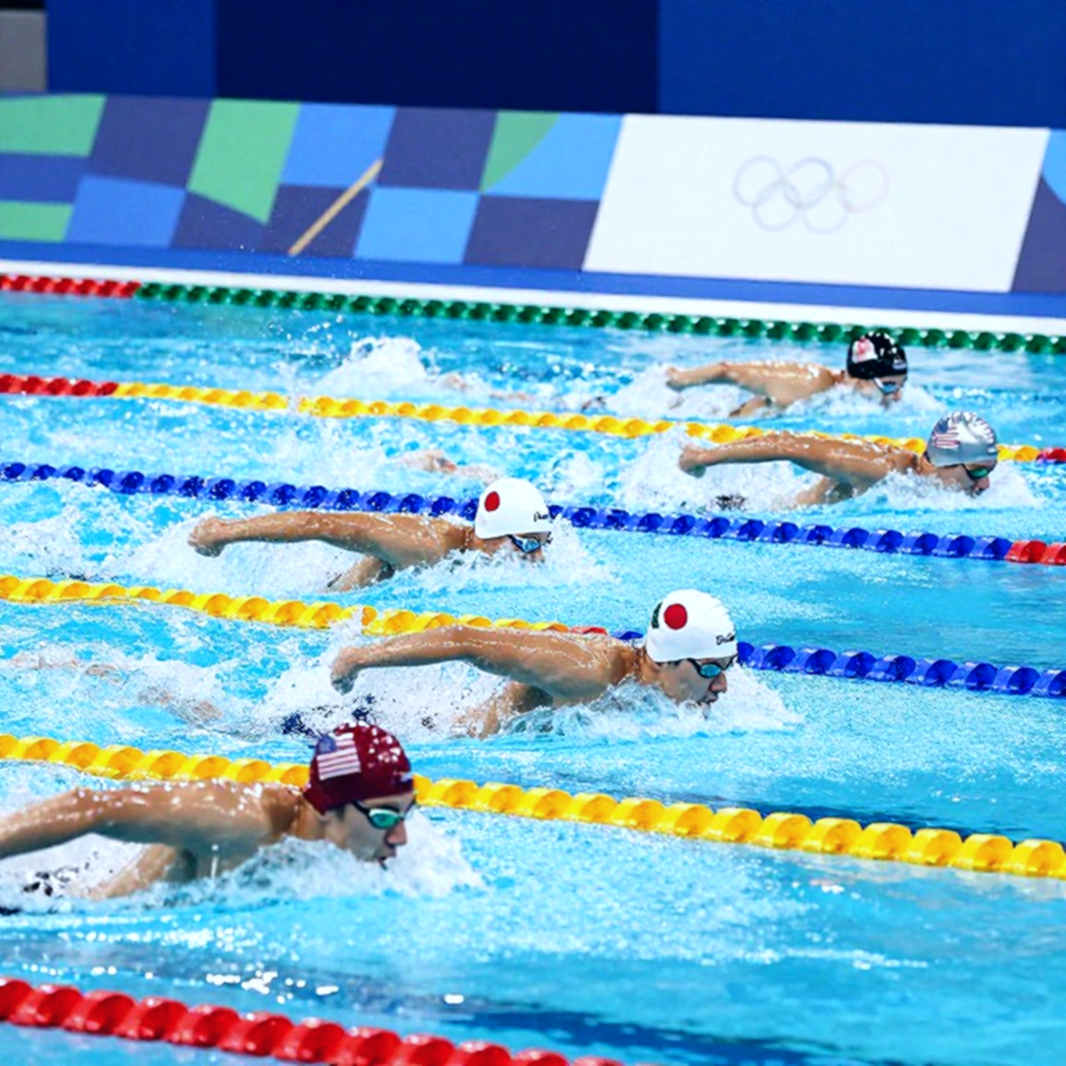
At international level, a race is divided into fifty-metre segments, each with its own time. How speed is distributed across those segments is the real story of the race: who goes out fast and dies in the last hundred, who holds an even pace like a machine, who empties everything into the final length. The men's 100m freestyle world record stands at 46.40 seconds, set by Pan Zhanle in the Olympic final in Paris on 31 July 2026. Leon Marchand swam the 400m individual medley in 4 minutes 02.95 seconds in the Olympic final in Paris on 28 July 2026, a figure accompanied by hundreds of lines of split analysis. Katie Ledecky set the women's 1500m freestyle world record at 15 minutes 20.48 seconds on 16 May 2026 in Indianapolis.
Each of those figures survives because of a system of record-keeping behind it: touchpads, cameras at each end of the pool, software that reconstructs the swimming trajectory. At domestic meets, we usually have only the winner's final time, and sometimes the winner's name. That means any serious analysis of Vietnamese swimming must begin with the simplest question: was this athlete fast or slow in the second fifty? Nobody can answer.
The pool was empty, and only the sound of water wept itself into a poem. I wrote that line on an afternoon long after the lights had gone out over the stands, thinking that the weeping was not for the end of the race but because nobody had written it down.
The competition layer: who goes, and by which road
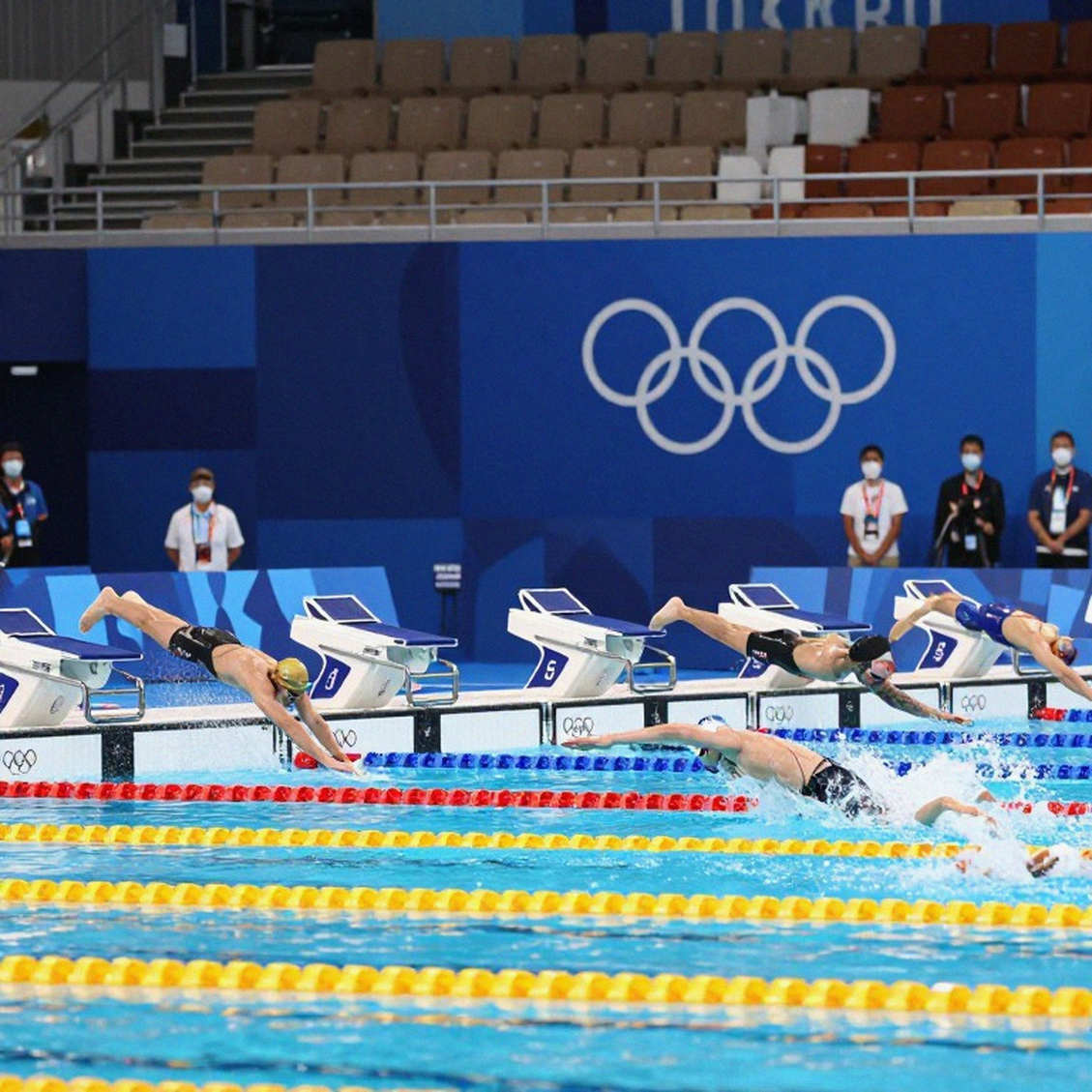
A ticket to the Olympic Games does not come from form; it comes from a qualifying time. World Aquatics sets A and B standards for each event inside a defined qualification window. Each country has a limited number of relay places, plus a universality mechanism for nations without representation. At home, the road begins at the national championship, then youth meets, then selection camps for the national team.
This layer needs three kinds of evidence: event names, the qualifying mechanism, and the list of selected athletes. We have the first and third in the form of short press releases. The second has almost vanished from the pages. Nobody publicly states how many hundredths of a second an athlete missed the standard by, in which event, in which window. No public qualifying tracker exists.
That turns every story about selection into a story about power rather than performance. Fans learn that a place is something someone grants, not something someone earns. The idea accumulates into a quiet bias, and when a young talent is left off a list, no line of data exists to argue with it.
The world map layer: a gap measured in depth
At the top level, world swimming is a densely packed map. The United States has a collegiate system with hundreds of scholarships a year, where an internal selection meet can be harsher than an Olympic final. Australia has a network of state institutes. France produces medley swimmers of Marchand's calibre. China has built a sprint cohort around Pan Zhanle. Britain once dominated men's breaststroke through Adam Peaty, who holds the 100m breaststroke world record at 56.88 seconds, set on 21 July 2026.
Vietnam sits at the edge of that map, in the position of lone individuals. A few athletes meet the standard, a few reach semi-finals at continental level, and there is almost no relay programme. But the world map does more than tell us where we are. It tells us what we are comparing ourselves to. When Australia can stage a trial where the fourth-place finisher is still good enough for an Olympic final, every comparison built on regional medal counts becomes distorted.
The map also reveals a gap few people discuss: a gap in records. Strong swimming nations do not hide data; they publish it as part of the selection process. An entire cohort's results can be looked up in public. That is why a foreign analysis can begin at the third fifty, while a domestic analysis must begin by finding out who swam at all.
The governance layer: what only appears when something breaks
Anti-doping is a field where silence counts as success. A good system is one nobody talks about. Athletes must file whereabouts, submit to unannounced testing, and apply for therapeutic use exemptions when a medication sits on the prohibited list. Disciplinary decisions are published, with the length of the ban.
From a data standpoint, the notable thing is that we have almost no public figures on how many tests are conducted each year at national level, broken down by sport or event. Swimming is a low-money sport with small television audiences compared with football, and testing resources tend to flow toward the loudest places. An anti-doping system without public data can still function well technically, but it cannot generate trust, and trust is the only asset swimming has to sell to a sponsor.
Within the same layer sit disputes over eligibility, relay squad status, and athletes changing sporting nationality. In Vietnam, such stories barely exist, partly because nothing has happened at significant scale, and partly because nothing is recorded.
The career layer: twelve years of swimming, three lines of file
A Vietnamese swimmer passes through three stages: learning at a local talent centre, being picked for a provincial youth team, then joining the national team. The most successful usually add a fourth stage: training abroad. Nguyen Thi Anh Vien trained long-term in the United States under coach Dang Anh Tuan, and that period overlapped with the peak of her career.
For most swimmers, though, a career file holds only a few lines: year of birth, hometown, a handful of youth national results, one appearance at a regional Games. Retirement usually lands between the ages of twenty-two and twenty-five. The time after that disappears.
Without career records, there is no way to talk about generational transition, and a swimming nation that cannot talk about generational transition will always be surprised when a generation leaves. We call it a gap in the squad, when in fact it is the consequence of nobody recording the development process.
The risk layer: uncharted waters
The biggest risk for a swimmer is a shoulder injury, followed by back and knee problems for breaststroke specialists. A third risk is mentioned less often: early specialisation. A nine-year-old swimming six sessions a week may win the twelve-year-old age group, then burn out physically and mentally by eighteen.
The fourth risk is institutional: training budgets depend on the Games cycle. Immediately after a successful Games, money flows. Two years later, when there are no more medals to count, the flow stops. Swimming is a sport that takes ten years to produce a champion and four years to lose a team.
Without injury data, we cannot tell whether a withdrawal reflects an individual accident or a flawed training model. Risk that is not recorded will always be narrated as fate, and fate is the most expensive way to tell a story.
The expectation layer: heroes manufactured once every four years
Vietnamese swimming enters the media spotlight on a four-year cycle, sometimes two. During that window, expectations are pushed very high, and each athlete becomes the embodiment of a quota. Outside that window, they barely exist in the press.
The gap between expectation and reality is measured in a strange currency: a continental silver is read as failure, while a semi-final place at an Olympic Games is the biggest result in years. That reading is emotionally honest but wrong in scale.
After a piece I wrote about an athlete who won no medal, a reader messaged me: "Why write about failure and spoil the fun?" I answered that I wrote about a person who swam two seconds faster than their own self, and those two seconds were real while the medal was not. A sport that is fair in its storytelling is one that lets small victories be named correctly, rather than compressed into a line of consolation.
The ripple layer: pools, contracts and the price of a spectrum band
In the final layer, a result turns into money. Sponsors sign athletes who win medals, swim centres raise fees, parents enrol their children after a Games, and a city adds one more pool to its master plan.
I have followed the sports rights market for years and keep seeing the same pattern: streaming platforms are paying high prices for rights without a long-term plan to recover the money, repeating the spiral of pay television two decades ago. That bubble has reached its limit, and it adds not a single dong to swimming in countries without a large market.
For swimming, the product on sale is not the race but the human story. Yet that story needs material, and the material lives in what is recorded. A sport that cannot sell broadcast rights can still sell attention, if it is willing to keep records.
The counterintuitive angle: the curtain of nine layers
The most striking thing about that two-page file is that it is not meaningless at all. It lists the correct nine layers, each with its own data requirements, done with real care and real professionalism. Then it concludes that the work cannot be done.
A framework beautiful enough can become a curtain over emptiness. We build twelve boxes to tick, nine dimensions to analyse, four criteria to score, and once they are built we are tired. The beautiful table replaces reading, replaces watching footage twice, replaces timing a race by hand in the stands.
In football, possession is the most deceptive index of all, because a team can hold sixty percent of the ball through meaningless sideways passes. In the Vietnamese version of swimming, the equivalent deceptive index is the medal table: correct about quantity and wrong about depth, correct about the moment and wrong about the span of time. Both are the kind of data that give us the feeling of understanding without the understanding itself.
A mistake made me read the world again with a slower breath. I once mispronounced a name, and the fix was not to memorise it correctly but to change how I prepared before opening my mouth. A blank analysis file should be read the same way: not as a refusal, but as a to-do list.
What remains
Nobody needs a nine-layer report to know that Vietnamese swimming lacks data. What is needed is far smaller: a hand stopwatch kept with discipline, a camera placed under the surface, a notebook tracking split times for ten athletes across one season.
I will start there, at a pool near my home, on Saturday morning. One person writes, one person films, and one coach agrees to open the doors thirty minutes early. People say a medal is an achievement; I say twelve lines of notes from one morning session also deserve to be called the history of a body of water.
If you have ever stood at the edge of a pool before sunrise and heard the water split in two by a child's hand, you know that what is happening there is not empty at all. It has simply never been counted.